Hotel slippers for hotels
All the decisive criteria explained compactly, with in-depth articles on every topic. For hotel buyers, housekeeping managers and operators of small properties.
Room, spa or pool: where will the slipper be worn?
The area of use is the most important decision, even before material or price. Each environment places different demands on slip resistance, moisture resistance and appearance.
Hotel room
- Comfort & appearance come first
- Soft materials (terry, velour)
- Disposable concept
- Strong influence on guest reviews
Spa & wellness
- Moisture resistance is a must
- 8 mm profiled EVA sole with cork footbed
- Open models preferred
- Disposable concept (ideal for hygiene)
Pool & sauna
- Full water resistance required
- 9 mm EVA sole with profile
- EVA material or flip-flops
- Quick-drying & robust
Hotel slippers open or closed: fit & feeling of comfort
The comfort level of a slipper results from three factors: fit (open/closed), sole padding and the feel of the material. All three noticeably influence how guests perceive it.
Closed
- Greater feeling of warmth and comfort
- Premium effect in the room area
- Guests wear them longer
- Size planning more critical
- Slightly higher unit price
Open
- One size fits all is easy to cover
- Cheaper to produce
- Quick to slip on and off in the spa
- Less premium effect in the room
- Less feeling of warmth
Comfort profile room
Comfort profile spa
Practical tip: Many hotels combine: closed terry slippers in the room and an open EVA or cork model in the spa. This covers both requirements optimally, without compromise.
Terry, non-woven, velour or cotton: what really looks premium?
The material is the strongest driver of perceived quality and at the same time the biggest cost lever. Here is the direct comparison of the four common upper materials.
Non-woven · Budget
Light, inexpensive, disposable concept. First choice for spas and budget hotels.
Velour · Premium
Silky feel, highest perceived value. For luxury hotels and suites.
Terry · Bestseller
Absorbent, soft, good premium effect. Standard in 4★/5★ hotels.
Cotton · Natural fibre
Pleasant and absorbent. Ideal for green hotels.
Hotel slipper price classes: economy, standard, premium, luxury
The price per pair is only one factor; what counts is the value for money in each area of use. This overview helps with budget planning.
Note: The prices are guide values for standard quantities. For larger volumes or individual conditions we can offer individual terms.
Request a quote →
Hygiene, branding & more
Beyond the four main axes there are further decision fields.
Hygiene & packaging
The packaging communicates cleanliness even before the first touch. Polybag, kraft paper band or TNT bag: each option sends a different signal to the guest.
Branding & logo
Personalised slippers strengthen the brand effect and end up in the luggage as a souvenir. Embroidery, colour customisation or packaging print: three ways to a branded slipper.
Materials
What slippers, amenities and guest accessories are made of, and where plastic is involved, is explained in the guide Materials and packaging in the hotel room.
Sizes & procurement
Large sizes such as 30.5 cm are often forgotten in procurement, which can lead to dissatisfied guests. The right size distribution and typical purchasing mistakes.
Sole and packaging: four guides on cork, jute and cotton
Slippers with soles of sugar cane, cork or coconut fibre raise their own questions. Four guides answer them.
Slippers of cork, jute and cotton
Eleven models for room and spa and their three components: upper, sole and packaging.
Soles of sugarcane, cork and coconut
Four soles, how they feel underfoot and the floor they are made for.
Cork and straw in wet areas
Which models hold up in spa, sauna and pool, and how they dry.
How the slippers are packed
How the pairs are packed individually and what housekeeping notices.
The route to the order in four steps
Four decisions in this order, and the order is set. Plus what came new into the portal in October 2026.
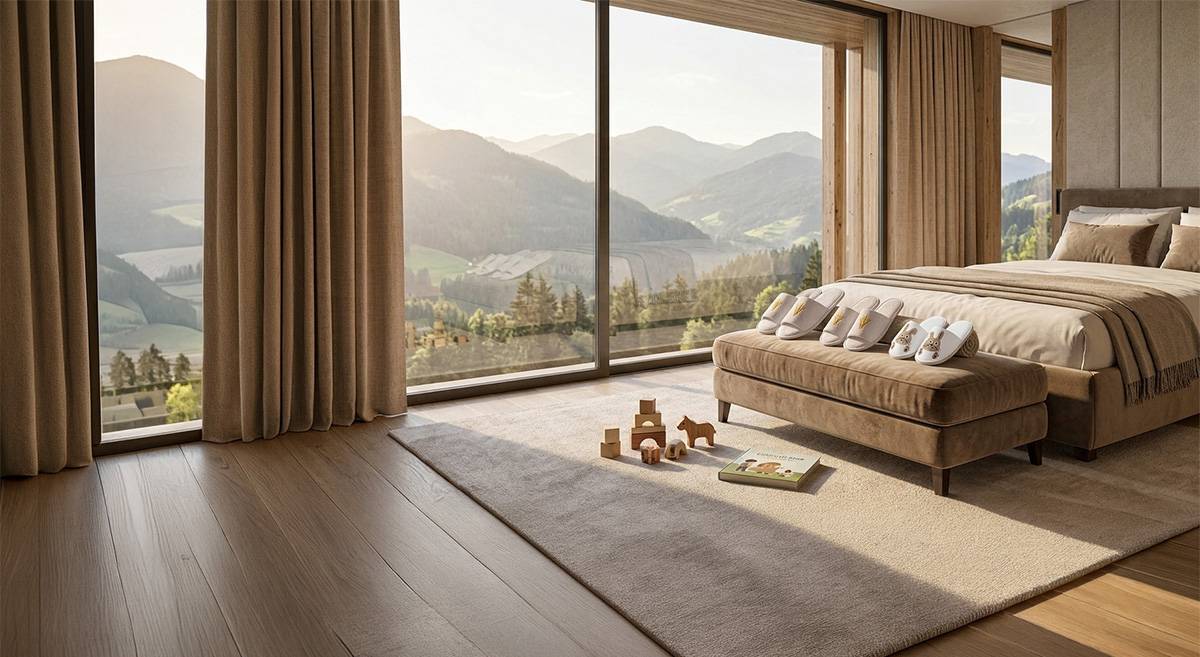
1. Define the place of use
Room, spa or pool: the place of use decides before material and price. Many properties combine two models, a closed one in terry for the room and an open one in EVA or cork for the spa. That way each area gets the slipper that suits its floor and its moisture.
2. Choose shape and material
The closed model feels warmer and more premium, and the guest wears it longer. The open model is quick to put on and take off and is easier to stock in one length for everyone. For the upper, non-woven is light and low in cost, terry is absorbent and soft, and velour has the most premium look.
3. Plan the length
The length is stated in centimetres for every model. Large lengths such as 30.5 cm are often forgotten in procurement, and the guest notices at once. For properties with families there are children's models of 24 cm.
4. Work out cartons and order
The calculator on this page works with two pairs per room and stay and a 10 per cent buffer. A carton holds between 85 and 400 pairs depending on the model, most often 200. Orders are placed in full cartons. From two cartons we deliver carriage paid; countries and exceptions are listed in the delivery information. In the portal you see all stock in real time.
New in the portal since October 2026
For the room: President Velour and President Terry, closed, white, 28.2 cm. Also Pelouche, closed, multicolour, 28.5 cm, and Cross wellness in black, 28.6 cm. For children: Dino and P-Andy Velour, closed, and Stockholm, open, all three at 24 cm. You will find each model by its name in the shop search.
Demand calculator: order quantity per room
How many slippers does your hotel need per month? Guide calculation for budget planning, based on two pairs per room and stay.
All articles on hotel slippers
Every topic in its own detailed article:
Frequently asked questions
Short answers to the most common questions