

Hotel slippers: open or closed?
How hotels choose correctly
With hotel slippers, a very practical question often arises before material and size: open at the front or closed at the front? Both variants usually exist in the same model and in the same quality. This is how you find the right shape for room, spa and season.
Open, closed and what both have in common
The difference between the open and the closed shape lies not in the workmanship but in the effect. The closed variant stands for warmth and a homely feeling, the open one for lightness and quick use. The sole remains the same in both cases.
Closed shape
- Encloses the forefoot completely
- Warmth and at-home feeling in the room
- Strong in the cooler season
- The most universal choice for every type of property
Open shape
- Leaves the toes free, airy and light
- Quick to put on, uncomplicated
- Natural choice for pool and sauna
- Suits a summery, Mediterranean ambience
EVA sole
- Identical for open and closed shapes
- Profiled, gives the foot hold
- Dry, stable feeling in damp areas
- Slip-resistant versions on request
When which shape is the right one
The question of open or closed cannot be answered in general, only along the place where the slipper is used. A slipper in the guest room fulfils a different task from one in the spa changing room. In the room it is about cosiness and about the guest arriving after the journey. In the wellness area it is about short distances, damp floors and the slipper being on the foot quickly in the half-light of the changing room. Anyone equipping both areas with the same shape makes no mistake, but gives away effect.
Closed hotel slippers: warmth and a homely feeling
The closed slipper encloses the forefoot completely. This is exactly where its effect comes from: the foot feels wrapped, not just covered. This conveys warmth and a cosy at-home feeling, which makes the closed slipper the obvious choice for the guest room. The difference becomes particularly clear in the cooler season and in properties with stone or tiled floors, where an open model separates the foot from the floor but hardly retains any warmth.
The shape also plays a role in the appearance of the property. The closed variant looks more valuable and calmer because it covers the foot completely and therefore looks tidier. For properties in the upscale segment, for boutique hotels and for everything that is meant to convey a cosy, high-quality image, it is therefore the safe standard. It also has the practical advantage of remaining coherent all year round. Anyone who wants to stock only one shape goes least wrong with the closed one.
Open hotel slippers: airy and uncomplicated
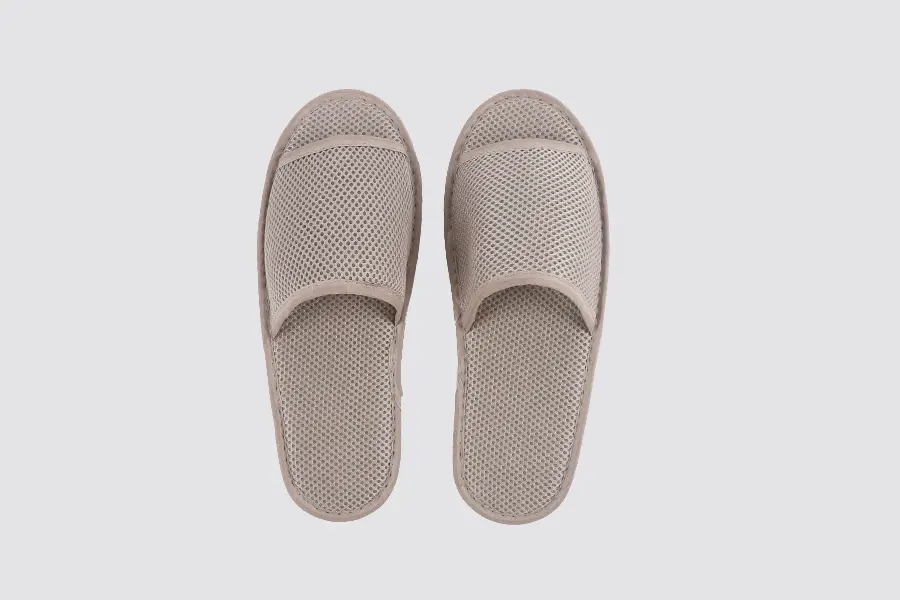
The open slipper leaves the toes free. It is airy, uncomplicated and precisely for that reason the natural choice for the wellness and spa area, for pool and sauna and for the warm months. In the spa the slipper is worn several times a day, mostly with damp feet. Here the open shape pays off: there is less material against the wet foot, air reaches the toes, and the slipper dries faster between uses. A closed model stores the moisture in the forefoot area and feels clammy when put on the second time, which cancels out the comfort advantage of the closed shape precisely where it is supposed to count.
Because the foot is not completely enclosed, the open variant looks fresh and light. In properties with a summery or Mediterranean ambience it supports the overall picture, where a closed model quickly looks heavy. Then there is the material aspect: many eco-oriented models, for example with a straw footbed, are deliberately designed as an open variant because the natural materials used come into their own best in this shape. Anyone equipping in the green segment will therefore find predominantly open versions there anyway.
Two shapes in parallel or just one?
In practice many properties run two lines: closed slippers in the room, open ones in the spa, sauna and pool area. This is the clean solution in terms of content, because each area gets the shape that works there. However, it means two positions in the store, two order units and, with personalised models, two versions each with its own minimum quantity.
Anyone who wants to avoid this decides according to focus. A city hotel without a wellness area does not need an open variant. Conversely, a holiday property with a large pool area and seasonal operation in summer can equip completely with open slippers. A third, often overlooked option is the seasonal switch: closed slippers in the cold half of the year, open ones in the warm half. This keeps the number of variants carried at the same time small and still matches guests' expectations.
In short: Room and winter speak for the closed shape, spa, pool and summer for the open one. Anyone who can only carry one variant chooses the closed one; it is the more universal choice.


Comfort and sole: equally good with both shapes
A widespread misunderstanding in procurement is the assumption that the open variant is the simpler or cheaper version. That is not the case. The choice between open and closed concerns the look and the wearing feel, not the quality of the sole and not the workmanship. Both shapes come from the same production, with the same upper materials and with the same sole underneath. Anyone who opts for the open variant does not save on quality but makes a decision about the area of use.
The EVA sole and what it does
Both variants are available with a profiled EVA sole in a usual thickness of 3 to 5 mm. This combination is a good compromise in everyday hotel life. The sole is thick enough to separate the foot from the cold floor and give the step a cushioned calm, but thin enough to remain light, flat to stack and space-saving in shipping. The profile gives the foot a pleasant hold and, especially in damp areas, ensures a dry, stable feeling because water is channelled away and does not remain as a film between foot and floor.
For procurement, the sole thickness is the more important lever than the question of shape. Thinner versions are more economical and perfectly adequate for short distances in the room. Where guests cover longer distances, for example from the room to the spa area or along corridors with hard floors, the thicker sole pays off in perceived comfort. The same consideration applies to properties with a high proportion of older guests, who perceive noticeable cushioning more clearly.
Putting slip resistance into perspective
A slip-resistant sole gives some hold on smooth floors and reduces the risk in spa, pool and bathroom. It is a sensible feature, but not a guarantee. How well it works depends on the floor, on the surface structure of the tiles and, to a considerable extent, on the cleaning agents used. Many care products leave a fine layer that, in combination with water, tends to become slippery and clearly weakens the effect of the sole. This is not a material defect but an interaction that can only be controlled via the cleaning routine.
For this reason, expectations are always part of the equipment. A slip-resistant slipper is made for normal walking, not for running or jumping. Those who walk calmly get considerably more safety from the soles; those who hurry undermine them. In high-risk areas the equipment is therefore only one building block alongside flooring, choice of cleaning agents and signage.
What you should not judge by the shape
Neither hygiene nor durability depend on the question of open or closed. Both shapes are designed for temporary use during a stay, both are available individually packed, and both can be personalised with logo print or embossing. Nothing changes in the choice of size either: it is specified in centimetres of sole length, regardless of the shape. What you can judge by the shape is the effect on the guest, and that is quite measurable in satisfaction when first entering the room or the spa changing room.
to the material overview →Frequently asked questions
Short answers to the most common questions
Open, closed or both?
We match the shapes to your areas, from room equipment to the spa changing room, including a quantity recommendation.