

Choosing the right hotel slipper sizes:
unisex, men's sizes & children
The most common wrong purchases of hotel slippers are not about the material but about the size. A slipper that is too small feels uncomfortable, and a missing children's model makes family hotels look bad. This is how you plan the size range sensibly and avoid complaints and reorders.
The three size classes at a glance
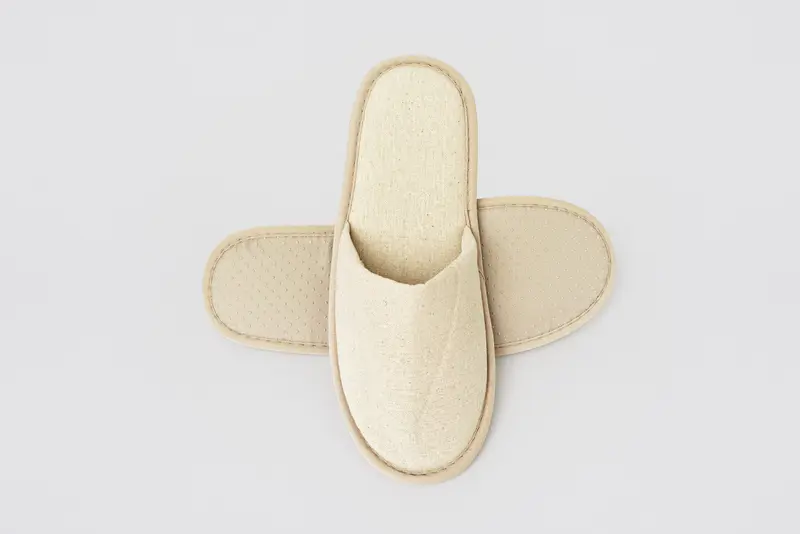
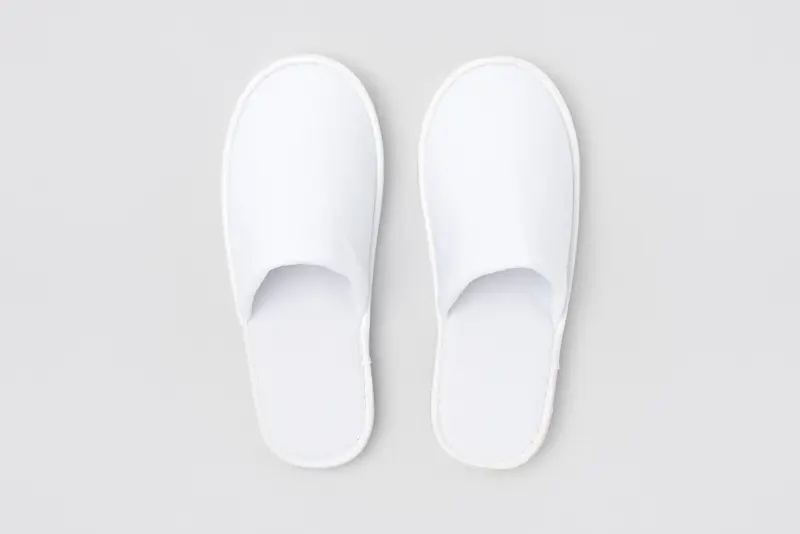
Hotel slippers are not specified in shoe sizes but in centimetres of sole length. Three classes cover almost every guest profile in practice, from the economical one-size model to a dedicated children's model.
Unisex standard
- Covers the majority of adult guests
- One model, one size
- Simple stock keeping
- Economical basis for every property
Men's size
- For larger feet, where the one-size model ends
- Ideal for business and sports hotels
- Small range, far fewer complaints
- Complements the unisex size, does not replace it
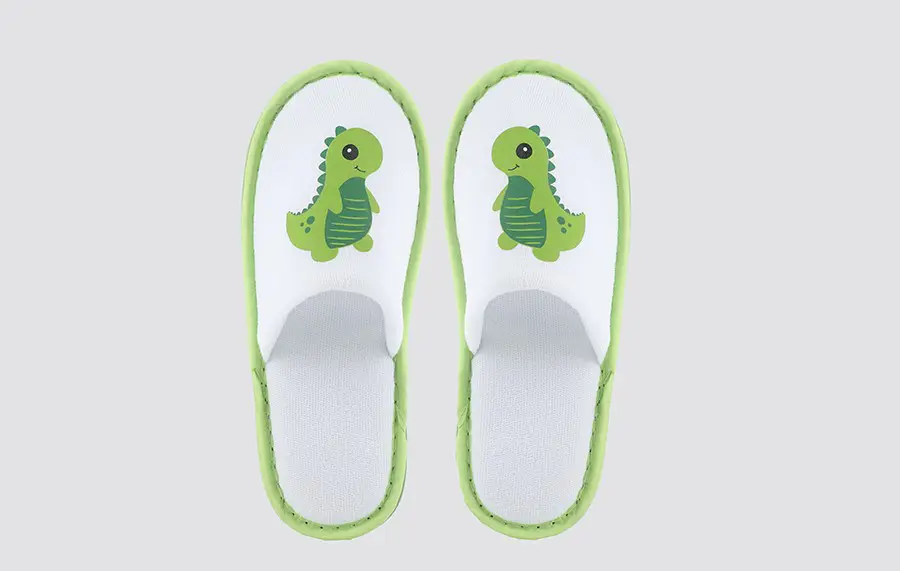
Children's slippers
- Dedicated lengths for children's feet
- A visible signal to families
- No child in oversized adult slippers
- Ideal for family and wellness hotels
Children's slippers for family hotels
When equipping guest rooms, family and wellness hotels face a question that classic city hotels do not know: what does the child get? In practice there are usually two answers, and both are bad. Either there is no slipper at all for the child, or it gets an adult one-size model. Parents notice both immediately, precisely at the moment they enter the room for the first time and form a judgement about your property.
Why adult sizes do not work for children
A unisex slipper with around 28.5 cm sole length is not simply too big for a child's foot, it is unusable. The sole sticks out at the front and sides, the child gets no hold and shuffles instead of walking. On tiled floors, in the bathroom and especially on wet surfaces in the wellness area this becomes a real safety issue. The protruding sole acts as a tripping edge, while the slip-resistant structure cannot take effect because the foot is not standing on the surface intended for it. Children's sizes are therefore not just about looks, but about sure footing.
Children's slippers as a signal of family friendliness
Families book differently from business travellers. They compare more intensively, they read reviews more closely, and they pay attention to whether a property only advertises family friendliness or actually delivers it. Anyone advertising family-friendly facilities is measured by such details. A dedicated children's slipper waiting at check-in is a visible signal that the youngest guests have been thought of. Compared with the overall budget for room equipment it costs very little and is noticed far more often than average. Children frequently take the slippers home, so a personalised model with your logo also works as a memento of the stay.
Stock children's sizes according to need, not across the board
Children's slippers do not have to be in every room. Consumption can be controlled via the booking data: wherever a cot, an extra bed or a family occupancy is noted in the system, housekeeping puts out the matching size. This keeps the quantities small and calculable without building up stock that is not needed. What matters is clear labelling in the store and on the housekeeping trolley. If adult and children's models are individually packed and look similar, they quickly end up in the wrong room, and the advantage of the dedicated size is lost.
The spa and wellness area also deserves a look at children's sizes. Many properties work with family times or dedicated areas for children. If slippers are provided there, the matching lengths should be available in the changing room, otherwise children walk barefoot across wet tiles.
Practical tip: Put out children's slippers based on the booking data, not across all rooms. This keeps consumption low, and the family still experiences fully thought-out equipment.
Planning the size range sensibly
The right size range does not come from the catalogue but from your guest profile. Three questions lead to the answer: who mainly stays in your property, how many arrivals do you record per month, and are the slippers personalised? Depending on this, the range is lean or somewhat broader.
Size distribution by hotel type
For a city or business hotel with a predominantly adult, often male public, the unisex standard size as a basis is usually sufficient, supplemented by a men's size up to 32 cm. A ratio of roughly four parts unisex to one part men's size is a workable starting value that you refine after the first months on the basis of actual consumption. In sports and conference hotels with group arrivals, the share of the men's size may be higher. Family and wellness hotels add the children's sizes, but manage with a small share there because demand is controlled specifically via the bookings.
Calculating slipper consumption realistically
Hotel slippers are a product per guest and stay, not per night. The calculation basis is therefore not room occupancy in nights but the number of arrivals. Multiply the average arrivals per month by the average number of persons per arrival, and you have the monthly basic demand in pairs. You then distribute this value across the size classes. Add a surcharge for the wellness area, replacements in case of damage and for guests who ask for a second pair. Anyone who sets up this calculation properly once avoids the two typical mistakes: empty shelves in high season and tied-up capital in sizes that hardly move.
Why fewer variants are more economical
Every additional size means its own position in the store, its own order unit and its own minimum order quantity. This becomes particularly relevant with personalised slippers with logo print, because minimum quantities there usually apply per version, not per order. A broad range can therefore make procurement considerably more expensive than the mere unit price suggests. The pragmatic way: a unisex standard size as the load-bearing basis, a men's size for the outliers upwards and, with a family public, children's sizes in small quantities. With three variants you cover almost every need without overloading storage and ordering processes.
Labelling and reordering
A good range is useless if the sizes cannot be told apart in everyday life. Separate the variants visibly in the store, label the packaging units clearly and define which size goes to which room as standard. In addition, every size needs a defined minimum stock at which reordering takes place. Take into account the seasonal peaks of your property, i.e. holiday periods for family hotels and trade fair or congress dates for business hotels, as well as the longer lead times for individually printed slippers. This turns the topic of sizes into a routine instead of a recurring bottleneck.
to the demand calculator →Frequently asked questions
Short answers to the most common questions
Unsure about the size range?
We put together the right combination for your guest profile, including a quantity recommendation.